

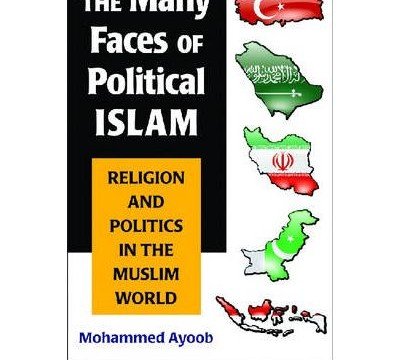
Written by; Mohammed Ayoob,
University of Michigan Press, 2008
Reviewed by; Robert Springborg
Although explicitly aimed at students in introductory courses and at nonspecialist readers, this is no dumbed-down textbook. Its argumentation is sophisticated, convincing, supported with ample empirical detail and presented in crisp, clear prose. While it does indeed fill the gap of a suitable introductory text to the subject, it will also be of value to specialists because of its intellectual merits and the wide scope of its coverage. Those familiar with the author’s previous works on the subject will find here a useful crystallization of his ideas, combined with an expanded empirical universe that stretches from Morocco to Indonesia.
The fundamental message of the book is that Islamism is a political rather than a religious phenomenon, and hence must be understood within the framework of the nation-state. Because this approach flies in the face of much accepted wisdom about the phenomenon, which among other things overstates the religious, enduring, and transnational natures of Islamisms. Ayoob consciously sets himself the task of “de-mythification.” Noting that political Islam is a modern phenomenon, an “invention of tradition” because there never was an Islamic state and no such concept within the Quran, he goes on to contest notions that mixing religion and politics is unique to Islam, that political Islam is monolithic; and that it is inherently violent.
While in reality religion and politics were demarcated very soon after the death of the Prophet, the fiction of their indivisibility was maintained as a strategy of regime legitimation by the three great Sunni dynasties: the Umayyad, the Abbasid and the Ottoman. But in all, the religious establishment was subordinate to temporal authority, a relationship that has continued within Arab successor states, including Saudi Arabia, where the House of Saud has held sway over the institutionalized manifestations of Wahhabism. Ayoob concludes that the relationship between religion and politics in Islam has not differed substantially from that in Christianity, with the exception that the more coherent organization of Christianity gave rise to more direct conflicts between temporal and religious authority in Europe. He notes the paradox that, while the development and application of law in Islam occurred within civil society and primarily beyond the sphere of the state, contemporary Islamists contend that the state should be the instrument by which the sharia is applied and extended, thus departing from traditional Muslim practice. He concludes his debunking of the din wa dawlamyth by stating that “Islam is no more politicized than Judaism and Christianity. . . ” (p. 14).
As for what he sees as the misleading contention that Islamism is monolithic, he notes that this arises in some measure from the fact that Islamic vocabulary, which springs from the same sources, transcends political boundaries. But, in fact, “no two Islamisms are alike”; they are all conditioned by the national contexts within which they originate and operate (p. 15). Similarly, Islamisms’s association with violence is debunked on the grounds that most such movements operate peacefully and seek to affect polities through constitutional means, even when the rules of the political game disadvantage them.
The rise of Islamism is explained as the result of the colonial dialectic, in which deficiencies in Muslim societies by comparison to their imperialist conquerors were seen by Salafis, such as Muhammad Abduh and Rashi Rida, as resulting from deviating from the path laid out by their “righteous ancestors.” Hence, the term Salafi. From its inception, therefore, Islamism was concerned with jihad, which was given the contemporary meaning of a struggle for national independence while using the vocabulary of classical Islam. A further impact of colonialism was to undermine the role of religious scholars, the ulama, while stimulating the emergence of Islamist thinkers who had not received classical training and whose primary concern was political, not religious.
Precisely because Islamism arose within specific historical and national contexts, it is extraordinarily diverse. So it is more appropriate to speak of Islamisms or, as Chapter Two suggests, “Islam’s multiple voices,” than it is of any essentialist Muslim society. Manifestations of this diversity include the views of contemporary Islamist intellectuals, such as Fazlur Rahman, Abdolkarim Soroush and Tariq Ramadan. In sum, “no individual, group or tendency in the contemporary era …can speak authoritatively on behalf of Muslims, let alone Islam” (p. 41).
The book’s intellectual framework thus established, it proceeds to undertake paired case studies of “self proclaimed Islamic states” (Saudi Arabia and Iran); states confronting ideological and pragmatic Islamisms (Egypt and Pakistan); Muslim democracies (Turkey and Indonesia); and Islamist national resistance movements (Hamas and Hezbollah). The final empirical chapter is devoted to various manifestations of transnational Islam, commencing with al-Afghani and including Tablighi Jamaat, Hizb al-Tahrir, al-Muhajiroun, and of course al-Qaeda.
This comparative approach is an excellent tool with which to illustrate the overall diversity of Islamism as well as substantial variations within even similar categories. Thus, in the case of the two self-proclaimed Muslim states of Saudi Arabia and Iran, for example, what is most apparent are profound political differences, the former being an anti-constitutional monarchy and the latter a constitutional republic. In both cases, these states are modern constructs, as Islam does not prescribe any particular model of rule, whether authoritarian, democratic or structural.
The comparison of Egypt and Pakistan illustrates how the relatively competitive and more democratic nature of the latter nurtured Islamists more committed to democracy than the former, but that in both cases Islamists have chosen the tool of the Leninist-style political party to pursue their interests. As regards differentiation and even contestation between ulama and lay Islamists such as Mawdudi, Hassan al-Banna and Sayyid Qutb, Ayoob observes “hybridization” occurring as the former become more radical and the latter more moderate. Al-Azhar and the Muslim Brotherhood, in other words, are beginning to join ranks intellectually and operationally in their opposition to the Mubarak regime.
Underlying the democratization of Islamists in Turkey and Indonesia is the successful economic globalizations of both countries. These export-oriented economies have facilitated the rise of an Islamist bourgeoisie or what might be thought of as a successful synthesis of globalizing and moralizing. Having increasing economic and political stakes in their countries, Turkish and Indonesian Islamists have become increasingly moderate. They have even become more active defenders of globalization and democratization than the secular forces they have supplanted, especially their respective militaries.
While the politically and economically benign environments of Turkey and Indonesia underlay the emergence of moderate, development-focused Islamism there, in Palestine and Lebanon the shortcomings of state and nation are reflected in the radical, violence-prone nature of Hamas and Hezbollah. Although both are profoundly different than al-Qaeda — their political objectives are territorially focused and their political Islam is a surrogate national-liberation ideology — it cannot be contended that either is going to evolve into a normal political party any time soon. Both reflect the “abnormal situations of occupation and state debility — along with the corollary of external intrusion” (p. 130). Their transformation into political parties is impeded by those structural constraints, not by their Islamist ideologies.
The treatment of transnational Islam emphasizes its lineage back to al-Afghani, illustrates that it has nonviolent as well as violent forms, and contends that even the apparently successful al-Qaeda is unlikely to have lasting impact on Muslim societies. Its transnational agenda is at odds with the needs and concerns of most Muslims, which are focused on their own states and reflect their own national interests. The apparent weakening of al-Qaeda in Iraq at the hands of Sunni Islamists would seem to provide evidence for the proposition that state-based political Islam is likely to trump its transnational competitor, even in circumstances quite favorable to the latter.
The concluding chapter presents well-developed arguments as to how authoritarianism favors the rise of Islamism within oppositions at the expense of secularists and why the exercise of U.S. power has recreated the colonial dialectic, again stimulating the rise of radical, liberationist Islamism.
Because Ayoob’s arguments are clearly presented and forcefully made, it is an easy task to stake out counterarguments, whether they are true or not, a pedagogical exercise that should serve to reinforce the book’s value as a text. That the nation-state is the sole independent variable here is a case in point. Might the rise of Islamism be attributed to other factors as well? How, for example, does this variable explain the rise of religiosity, which seems to be virtually a global phenomenon? And what relationship is there between growing Muslim religiosity and the rise of Islamism? Does this not indicate that a social movement, possibly independent of the state, explains at least part of the rise of Islamism? The extreme variant of this critique is that Muslim societies are returning to type after a long interlude of colonialism and postcolonial, quasi-secular rule. Left to their own devices, Muslim polities will be Islamist, or so it could be argued.
The argument that democracy begets moderate, democratic Islamism is supported with the empirical cases of Turkey and Indonesia and, to a lesser extent, Egypt and Pakistan. Yet, in the first two cases, the role of the military might also have been important in their democratic transitions. The military, in combination with a mobilized civil society, which in Turkey is strongly secular, has served as a constraint on Islamism. This has possibly induced it to accept half a loaf rather than try to impose Islamism on society. The moral, then, is that a comparatively open state, but one anchored by forces that can constrain Islamists, may be the optimal precursor for a transition to established democracy.
Some aspects of Islamism are not touched upon; were they, the tale might be somewhat different. Gender, sexual-preference and religious inequalities, which very few Islamists are willing to seek to erase, are primary obstacles to a citizenship-based state. Without this basis, democracy is impossible. The inward-looking, defensive nature of Muslims as revealed by the Pew Global Attitudes Project and similar surveys, combined with the Islam-as-victim presentation in school textbooks in Muslim-majority countries, also indicates a mindset that is not conducive to an open society. In sum, there is evidence that Islamism taps into deep-seated societal attitudes that make it hard for others, including secularists, to compete politically or even to be tolerated in some cases, let along be accorded full and equal rights. The argument that the AKP in Turkey has become a post-Islamist organization, focused not on identity but on service provision and fully committed to equal rights for all, would suggest that this evidence is irrelevant. However, this characterization of the AKP is premature, as Ayoob indicates.
A book of this scope and erudition is likely to contain a few errors, but this reviewer could only spot one. It was in the second half of the nineteenth, not the twentieth, century in which representative institutions began to emerge in Muslim countries (p. 90). The claim (p. 94) that Jordan has moved toward greater political openness is an error of interpretation, if not of fact.
Quibbles aside, the next time I teach a course on this subject, this is the book I shall use and strongly recommend that others do as well. It not only debunks pernicious myths, but puts a clear case that is far more right than wrong and serves as an excellent thesis against which antithetical ideas can be discussed.
Source: Middle East Policy Council

